فصلنامه علمی- پژوهشی اطلاعات جغرافیایی « سپهر»

فصلنامه علمی- پژوهشی اطلاعات جغرافیایی « سپهر»

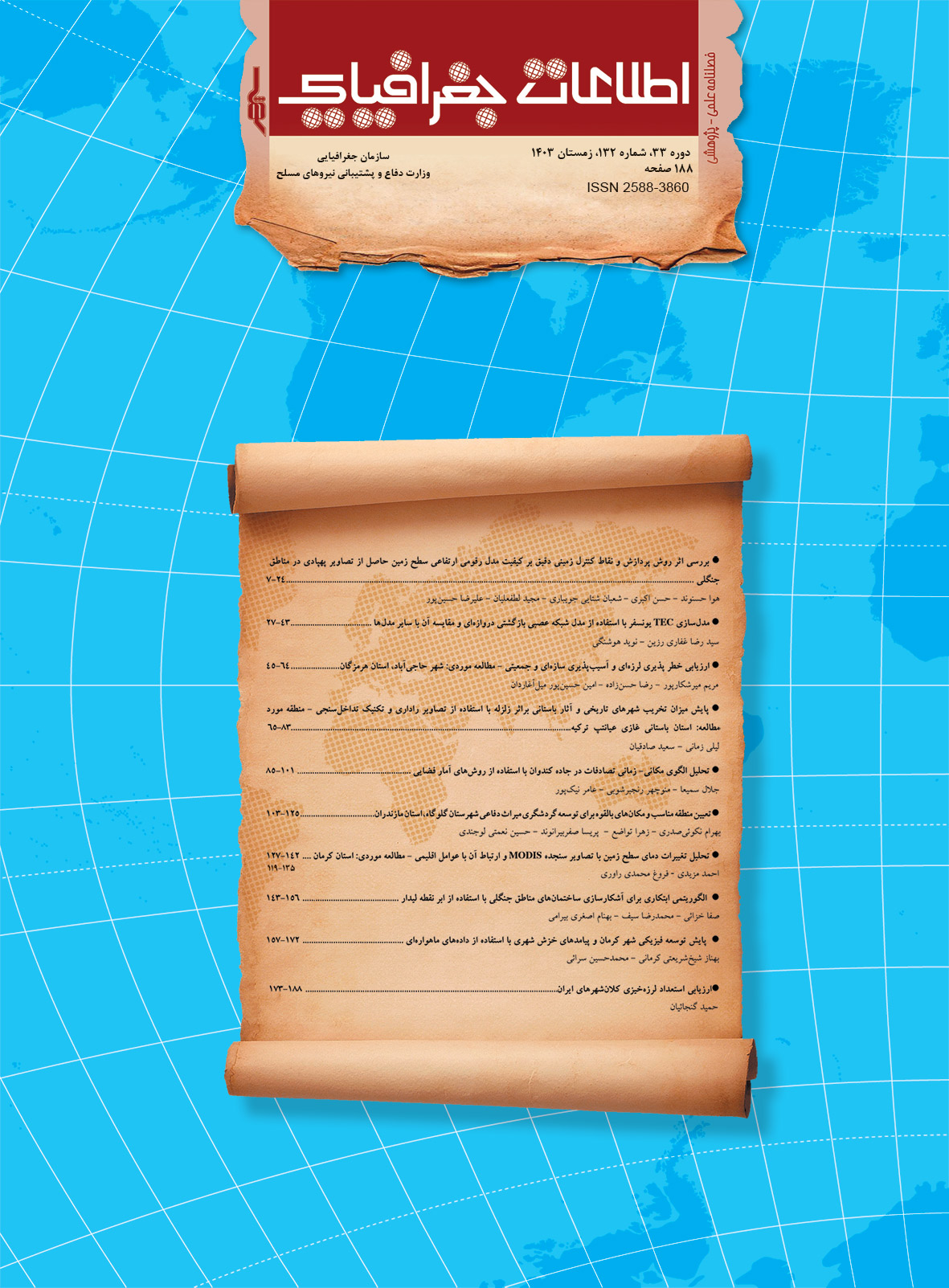
ارزیابی خطر پذیری لرزه ای و آسیب پذیری سازه ای و جمعیتی - مطالعه موردی: شهر حاجی آباد، استان هرمزگان

نوع مقاله : مقاله پژوهشی

نویسندگان
1 دانشجوی کارشناسی ارشد سیستم اطلاعات جغرافیایی، دانشگاه تحصیلات تکمیلی صنعتی و فناوری پیشرفته کرمان ،کرمان ، ایران
2 استادیار گروه اکولوژی، پژوهشگاه علوم و تکنولوژی پیشرفته و علوم محیطی، دانشگاه تحصیلات تکمیلی صنعتی و فناوری پیشرفته کرمان، کرمان، ایران
3 استادیار گروه مهندسی نقشه برداری، دانشگاه تحصیلات تکمیلی صنعتی و فناوری پیشرفته کرمان، کرمان، ایران
چکیده
رخداد زلزله در کشور باعث تخریب شهرها و روستاهای زیادی شده است. وقوع زمین لرزه‌های شدید در منطقه مورد مطالعه (دو زمین لرزه به بزرگی 6.4 و 6.3 ریشتری در تاریخ 23 آبان 1400 در نزدیکی شهر فین استان هرمزگان) و وجود گسل های فعال (اصلی زاگرس و تراستی زاگرس) در مجاورت شهر حاجی آباد می توانند باعث تخریب سازه ها و تلفات جمعیتی در این شهر شوند. بنابراین، هدف از انجام این تحقیق ارزیابی خطرپذیری لرزه‌ای، آسیب‌پذیری سازه‌ای و جمعیتی شهر در اثر وقوع زمین لرزه احتمالی است تا نواحی آسیب‌پذیر در برابر خطرات زمین‌لرزه مشخص شوند. به منظور اجرای این تحقیق داده‌های زمین‌شناسی، توپوگرافی و آب شناسی و داده‌های جمعیتی از سازمان‌های مرتبط در محدوده شهر حاجی‌آباد جمع‌آوری و  بر اساس مطالعات میدانی تعداد سازه‌ها و نوع سازه در هر محله برداشت شد. سپس نقشه پراکندگی سازه‌ها و نوع آن‌ها ترسیم شد. در مرحله بعد این داده‌ها در سامانه GIS آماده سازی و با استفاده از روش‌های تصمیم‌گیری چند معیاره مانند روش فرآیند تحلیلی شبکه‌ای (ANP) و روش منطق فازی (Fuzzy Logic) اولویت بندی و وزن‌دهی شدند. زیر معیارهای زمین‌شناسی شامل: فاصله از گسل، ضخامت آبرفت و جنس خاک و رسوبات؛ آب شناسی شامل: عمق آب‌های زیرزمینی و توپوگرافی شامل: شیب و بی‌نظمی توپوگرافی هستند. پس از وزن‌دهی این معیارها و زیر معیارهای هر یک با استفاده از روش ترکیب وزنی خطی (WLC) تلفیق شده، نقشه خطرپذیری زمین لرزه سناریو با بزرگی 7.1 ریشتر در شهر تولید شد. نتایج نشان می‌دهد 3.68 کیلومتر مربع از وسعت شهر در محدوده خطرپذیری خیلی زیاد قرار دارد. سپس با استفاده از روش های ارزیابی آسیب پذیری سازه ای و منحنی های شکنندگی توسعه یافته در ایران میزان تخریب سازه ها در شهر مورد ارزیابی قرارگرفت که مشخص شد در اثر وقوع زلزله‌ای به بزرگی 7.1 ریشتر، حدود 80 درصد ساختمان‌های موجود در شهر دچار تخریب بالای 70 درصد شده و حدود 11000 نفر از جمعیت شهر نیز دچار جراحت شدید یا کشته خواهند شد. نتایج این تحقیق می‌تواند کارشناسان و برنامه‌ریزان شهری را در حوزه مدیریت شهری و مدیریت بحران برای اجرای سیاست‌های کلان کاهش خطر زمین‌لرزه، ارتقا آمادگی در برابر وقوع زمین‌لرزه و اولویت‌بندی مقاوم‌سازی سازه‌ها در این شهر یاری رساند.
کلیدواژه‌ها

موضوعات


عنوان مقاله English

Evaluation of seismic risk and structural and population vulnerability a case study of Haji Abad city - Hormozgan Province

نویسندگان English

Maryam Mirshekarpour 1
Reza Hassanzadeh 2
Amin Hossinpour 3
1 M.Sc. Student in Geographic Information System, Graduate University of Advanced Technology, Kerman, Kerman, Iran
2 Assistant professor, Department of Ecology, Institute of Science and High Technology and Environmental Sciences, Graduate University of Advanced Technology, Kerman, Iran
3 Assistant professor ,Department of Surveying, Graduate University of Advanced Technology, Kerman, Iran
چکیده English

Extended Abstract
Introduction
Earthquake is one of the natural disasters that occurs suddenly and directly affects human life and urban and rural environment. Among the earthquake damages, we can mention human casualties, destruction of buildings and bridges, accumulation of building debris in the boundaries of roads and streets, destruction of electric poles, disruption of movement in the transportation system (Rikalovic, 2014). In order to determine the level of earthquake risk in a region, conducting seismicity studies has a high priority. Also, in order to identify vulnerable places in a city in order to make major decisions in the field of building improvement and retrofitting, it is necessary to carry out structural and demographic seismic vulnerability research (Ansal et al., 2009; Coburn & Spence, 2002).
The occurrence of severe earthquakes in the region (two earthquakes with a magnitude of 6.4 and 6.3 on the Richter scale on November 14, 2021 near the city of Fin, Hormozgan province) and the presence of active faults such as Main Zagros and Zagros Trust in the vicinity of Haji Abad city showed the region is exposed to the vey high risk of an earthquake occurnece that can cause the destruction of buildings and population losses in this city. Therefore, the purpose of this research is to assess the seismic risk, buildings and population vulnerability of the city due to a probable earthquake in order to determine the vulnerable areas against earthquake hazard.
Materials & Methods
In order to carry out this research, geological, topographical and hydrological data and demographic data were collected from related organizations in Hajiabad city. Based on field studies, the number of buildings and the type of structures in each neighborhood were collected, and a map of the distribution of buildins and their types was depicted. Then, these data were prepared in the GIS system and prioritized and weighted using multi-criteria decision-making methods such as Analytical Network Process (ANP) and Fuzzy Logic.
The sub-geological criteria include: distance from the fault, thickness of alluvium and the type of soil and sediments, hydrology includes: depth of underground water and topography includes: slope and irregularity of topography. After weighting these criteria and sub-criteria of each, they were  ombined using weighted linear combination (WLC) method, and an earthquake hazard map considering an earthquake scenario with a magnitude of 1.7 on the Richter scale was produced in the city. Later, the degree of buildings vulnerability based on the fragility curves that were developed based on past research in Iran were estimated in the classes of without destruction to completely collopsed, and the vulnerability of the population was calculated based on the statistics of the Bam earthquake in the classes of the number of healthy people, injured, injured and hospitalized, and dead people.
Results & Discussion
The results of seismic microzonation map showed that 3.68 square kilometers of the city is in a very high risk area. Then, based on building vulnerability assessment methods and fragility curves, the destruction level of buildings in the city was evaluated, and it was found that due to an earthquake with a magnitude of 7.1 on the Richter scale, about 80% of the buildings in the city were destroyed over 70% destruction level, and about 11,000 people from the city's population were seriously injured or killed as a result of this earthqauke occurence.
Conclusion
According to the results of this research, we found that the city of Hajiabad is surrounded by two main faults inclusing Main Zagros and the Trust Zagros faults, which has made it impossible to imagine any safe area in the city. On the other hand, the increase in population and urbanization has caused the extensive development of the city. Therefore, we need efficient disaster and urban management from the relevant organizations to prevent damage and overcome these crises. These measures inculdes rehabilitating worn-out buildings with low-quality materials, preventing construction in the high-risk areas of the city, making suitable plans to increase the resistancy against earthquakes in the city. Moreover, in order to increase security and speed up relief and response operations, in the areas where the risk is very high, according to the regulations, medical and fire stations should be built. In the vulnerable areas of the city where the population density is high, parks and open spaces should be built for temporary and safe accommodation after the earthquake. Therefore, the results of this research can help experts and urban planners in the field of urban management and crisis management to implement macro policies to reduce the risk of earthquakes, improve preparedness against earthquakes, and prioritize the retrofitting of buildings in this city.

کلیدواژه‌ها English

Earthquake
Building vulnerability
Analytical Network Process (ANP) method
Fuzzy Logic
Geographical Information System (GIS)
Haji Abad City
Hormozgan
1- Afifi, M. E. (2022). ‘Evaluation of Resilience of Urban Decay Texture against Earthquake using GIS (Case study: District 2 of Bandar Abbās Municipality)’, Geographical Studies of Coastal Areas Journal, 3(2), pp. 69-88. doi: 10.22124/gscaj.2022.21511.1142 (In Persian).
2- Aghayari, S. F., samadzadeh, R., masoumi, T. (2025). ‘An analysis of urban social and economic resilience against earthquakes(Case study of Khalkhal city)’, Geographical Engineering of Territory, 9(1), pp. -. doi: 10.22034/jget.2024.383111.1474 (In Persian).
3- Ansal, A., Akinci, A., Cultrera, G., Erdik, M., Pessina, V., Tönük, G., & Ameri, G. (2009). Loss estimation in Istanbul based on deterministic earthquake scenarios of the Marmara Sea region (Turkey) . Soil Dynamics and Earthquake Engineering, 29(4), 699-709.
4- Coburn, A., & Spence, R. (2002). Earthquake Protection. John Wiley and Sons.
5- Ekhlaspour P, Abbasnejad A, Nemati M. (2022). ‘Earthquake hazard zoning in Kerman Province using GIS and Fuzzy Logic method’. KJES; 7 (2) :270-285 (In Persian).
6- Erdocَan, S. and F. Terzi, GIS-based seismic vulnerability assessment for the Istanbul Historical 
7- Geological survey of Iran, (2002), Geological map of Hajiabad 1:100000. (In Persian).
8- Getis, A., & Ord, J. K. (1992). The analysis of spatial association by use of distance statistics. Geographical analysis, 24(3), 189-206.
9- Ghazanfar Pour, H., Hosseinekhah, H., Kamali, E. (2023). ‘The analysis of risk and vulnerability Seismic of human settlements in Basht County using fuzzy Dimatel and ArcGIS’, Journal of Natural Environmental Hazards, 12(35), pp. 21-36. doi: 10.22111/jneh.2022.39945.1845 (In Persian).
10- Gholami H, Shokouhi bidhendi M S. (2023). Relative evaluation of the vulnerability of the areas of Khorramabad city in terms of earthquakes using the hierarchical analysis method. Disaster Prev. Manag. Know; 12 (4) : 7 (In Persian).
11- Hajiabad Municipality, (2021), Comprehensive Planning of Haji Abad City (In Persian).
12- Hassanzadeh, R. (2019). Earthquake population loss estimation using spatial modelling and survey data: The Bam earthquake, 2003, Iran. Soil Dynamics and Earthquake Engineering, 116, 421-435.
13- Hassanzadeh, R., Honarmand, M., Hossienjani Zadeh, M., & Naseri, F. (2019). New approaches to modelling of local seismic amplification susceptibility using direct characteristics of influencing criteria: case study of Bam City, Iran. Nat. Hazards Earth Syst. Sci., 19(9), 1989-2009.
14- Hassanzadeh, R., Nedovicَ- Budicَ, Z., Alavi Razavi, A., Norouzzadeh, M., & Hodhodkian, H. (2013). Interactive approach for GIS-based earthquake scenario development and resource estimation (Karmania hazard model). The international jounal of Computers & Geosciences, 51, 324-338.
15- Heidarifar, M. R., Mahmoudi, A. (2021). ‘Analysis of Javanrud Urban Land Use Vulnerability to Earthquake, Using Network Analysis (ANP) and Geographic Information System (GIS)’, Human Geography Research, 53(1), pp. 119-137. doi: 10.22059/jhgr.2019.279271.1007898 (In Persian).
16- Japan International Cooperation Agency. (JICA), Center for Earthquake and Environmental Studies of Tehran (CEST), & Tehran Municipality. (2000). The study on seismic microzoning of the Greater Tehran area in the Islamic Republic of Iran.
17- Jena, R. and B. Pradhan. Earthquake vulnerability assessment using expert-based approach in GIS. in 2019 6th International Conference on Space Science and Communication (IconSpace). 2019. IEEE.
18- Kamranzad, F., H. Memarian, and M. Zare, Earthquake risk assessment for Tehran, Iran. ISPRS International Journal of Geo-Information, 2020. 9(7): p. 430.
19- Lalepour, M., Kirizadeh, M., Zakeri, M. (2022). ‘Assessing the vulnerability of urban areas to earthquake crises (Case study: Varzeqan city neighborhoods)’, Journal of Natural Environmental Hazards, 11(31), pp. 1-24. doi: 10.22111/jneh.2022.33931.1656 (In Persian).
20- Lang, K., & Bachmann, H. (2004). On the Seismic Vulnerability of Existing Buildings: A Case Study of the City of Basel. Earthquake Spectra, 20(1), 43-66.
21- Malczewski, J., & Rinner, C. (2015). Multicriteria decision analysis in geographic information science (Vol. 1, pp. 55-77). New York: Springer.
22- Management and Planning Organization of Hormozgan Province, (2015), Statistical Survey of Population in 2015. (In Persian).
23- Michel, C., Fäh, D., Edwards, B., & Cauzzi, C. (2017). Site amplification at the city scale in Basel (Switzerland) from geophysical site characterization and spectral modelling of recorded earthquakes. Physics and Chemistry of the Earth, Parts A/B/C, 98, 27-40.
24- Mohajer-Ashjai, A., & Nowroozi, A. A. (1978). Observed and probable intensity zoning of Iran. Tectonophysics, 49(3-4), 149-160.
25- Nyimbili, P.H., T. Erden, and H. Karaman, Integration of GIS, AHP and TOPSIS for earthquake hazard analysis. Natural hazards, 2018. 92: p. 1523-1546.
26- Ord, J. K., & Getis, A. (1995). Local spatial autocorrelation statistics: distributional issues and an application. Geographical analysis, 27(4), 286-306.
27- Regional Water Company of Hormozgan, (1993), Report on exploration wells’ log in Haji Abad Region. (In Persian).
28- Regional Water Company of Hormozgan, (2020), Information on Depth of water in Haji Abad Region. (In Persian).
29- Rikalovic, A., Cosic, I., & Lazarevic, D. (2014). GIS based multi-criteria analysis for industrial site selection.Procedia engineering, 69, 1054-1063.
30- Saaty, T. L. (2004). Decision making—the analytic hierarchy and network processes (AHP/ANP). Journal of systems science and systems engineering, 13, 1-35.
31- Sauti, N.S., et al., GIS spatial modelling for seismic risk assessment based on exposure, resilience, and capacity indicators to seismic hazard: a case study of Pahang, Malaysia. Geomatics, Natural Hazards and Risk, 2021. 12(1): p. 1948-1972.
32- Yager, R. R., & Zadeh, L. A. (Eds.). (2012). An introduction to fuzzy logic applications in intelligent systems (Vol. 165). Springer Science & Business Media.
33- Yokoyama, O., & Takahashi, K. (2003). Planning for air pollution abatement in the greater Tehran area (GTA) in the Islamic Republic of Iran (JICA Project 1995-1997). pure and applied geophysics, 160(1-2), 17-19.
34- Zadeh, L. A. (1965). Fuzzy sets. Information and control, 8(3), 338-353.
35- Zadeh, L. A. (1975). Fuzzy logic and approximate reasoning. Synthese, 30(3), 407-428.